The Complete First-Time Home Buyer's Guide to Kitchener-Waterloo (2026 Edition) 🏡A step-by-step roadmap from your first pre-approval conversation to the day you get your keys — built around

Dated: September 23 2026
Views: 65
The listing looks like a freehold townhouse or detached home — yet it comes with a monthly fee. Is it a condo? An HOA fee? Optional? Here's exactly what that fee means, and how to budget for it.

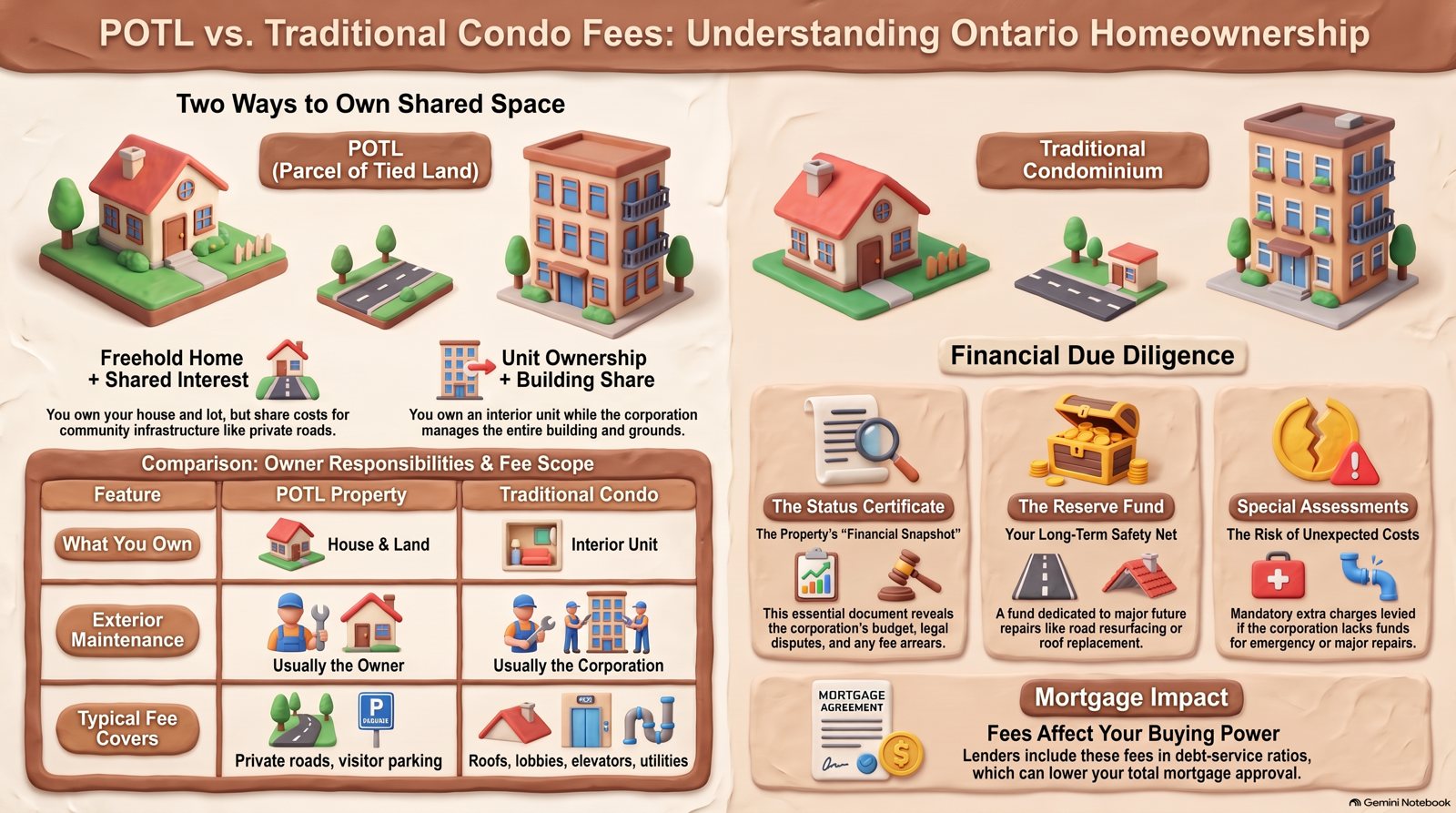
A POTL fee and a traditional condo fee are both mandatory monthly expenses, but they're tied to different forms of ownership. A POTL (Parcel of Tied Land) property is usually a freehold home — you own the house and land — that's legally tied to a common-elements condominium corporation covering shared assets like private roads, visitor parking or landscaping. A traditional condo fee funds the building itself: the roof, hallways, elevators, insurance and amenities.
A lower fee doesn't automatically mean lower total ownership costs, and a higher fee doesn't automatically mean poor value. The question that actually matters is: what does the fee cover, what doesn't it cover, and how healthy is the reserve fund?
Buying a home in Ontario often comes with a surprise for first-time buyers: the listing may look like a freehold townhouse or detached home, yet it includes a monthly fee. Is it a condo? A homeowner-association fee? Optional? And what exactly does "POTL" mean?
The answer matters. A POTL fee and a traditional condo fee can both be mandatory monthly expenses, but they're connected to different forms of ownership, different responsibilities, and different due-diligence questions. If you're considering a freehold townhome in Kitchener, Waterloo, Cambridge, or elsewhere in Ontario, understanding the difference can protect your budget and help you avoid costly assumptions.
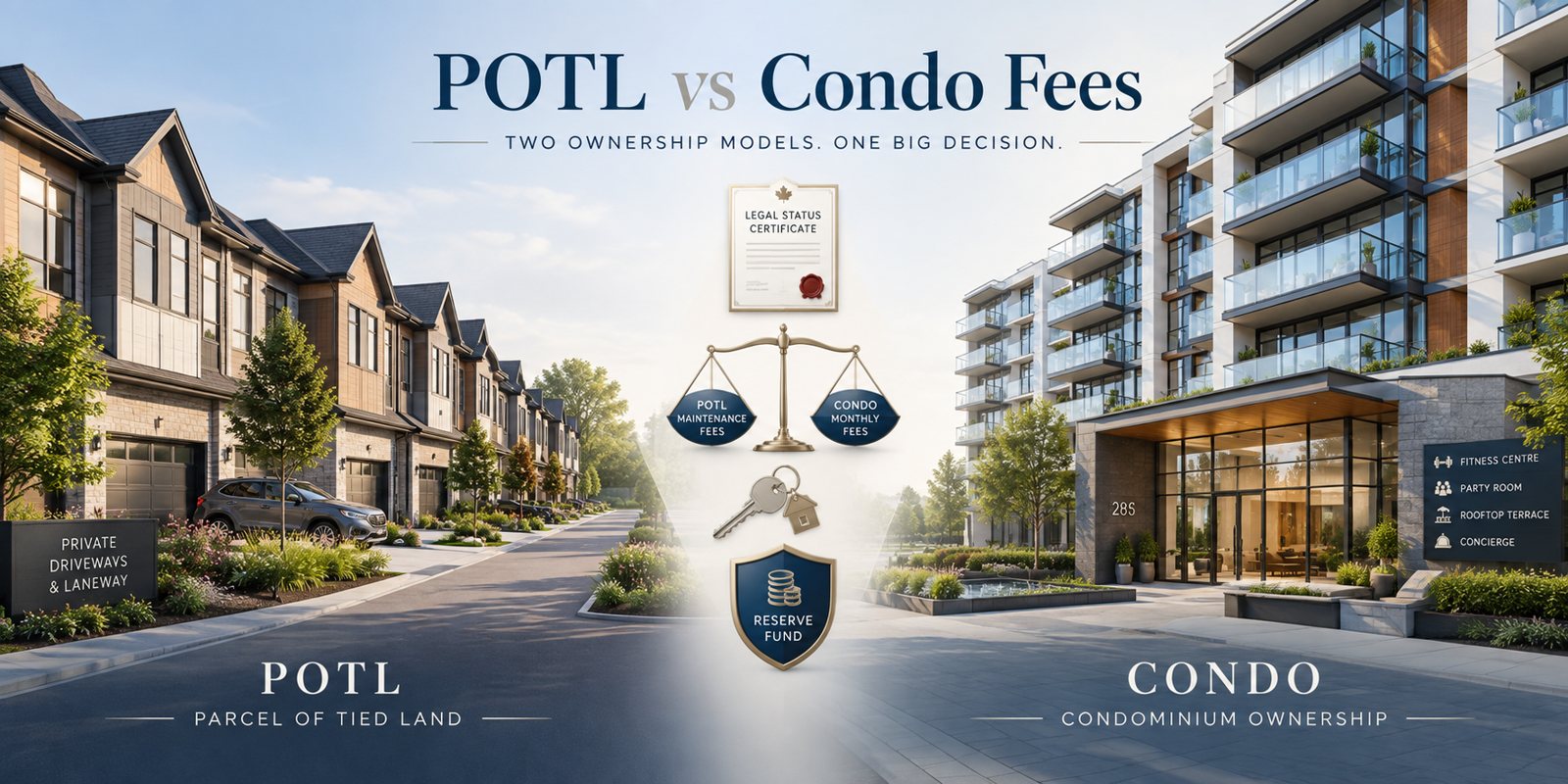
POTL stands for Parcel of Tied Land. It's often associated with a common-elements condominium corporation. In this structure, the homeowner owns a freehold parcel of land — such as a townhouse lot, detached house lot, or vacant-land-style property — but that ownership is legally tied to a common interest in shared condominium elements. Ontario's Condominium Act recognizes common-elements condominium corporations where an owner's common interest is attached to their parcel of tied land.
In plain language, you may own your house and lot, but you also own a shared interest in certain community assets. These shared assets may include private roads or laneways, visitor parking, shared landscaping, entrance features or gates, a private park or recreation space, community mailboxes, stormwater-management infrastructure, snow clearing for private roads, shared lighting, private garbage or waste-management systems, and sometimes amenities like a pool or clubhouse. The exact features vary dramatically from one development to another — never assume a POTL fee includes the same items as another community's fee.
POTL arrangements are common in modern developments where several homes share infrastructure that isn't maintained by the municipality — a group of freehold townhomes might share a private laneway, visitor parking, street lighting, landscaping and snow clearing that the municipality never takes on. For buyers, this can offer a real balance: a more traditional freehold-style home combined with organized shared-area management.
Condo fees, formally known as common expenses, are recurring payments made by condominium owners to the condominium corporation. These fees support operating costs and contributions to the reserve fund. The Condominium Authority of Ontario notes that condo fees — also called common expenses or maintenance fees — help fund operating expenses and reserve-fund contributions for the upkeep of common elements.
In a traditional condominium, common elements typically include the building exterior and roof; the lobby, hallways, elevators and stairwells; heating, cooling, plumbing or electrical systems serving common areas; concierge or security services; a gym, pool, party room, rooftop terrace or other amenities; landscaping and snow removal; garbage removal; the parking garage and visitor parking; windows and balconies depending on the declaration; and insurance for common elements and the corporation's assets.
Condo fees aren't optional. Under Ontario's Condominium Act, owners must contribute to common expenses according to the proportions set out in the corporation's declaration — even if you never use the gym, pool or party room, you generally can't opt out of paying your share.
Condo fees aren't simply based on the age or size of a building. They can vary based on your unit's size and allocated percentage interest, the building's amenities, staffing and security costs, utility inclusions, insurance costs, the age and condition of the building, reserve-fund requirements, the number of units sharing costs, the corporation's operating budget, recent or planned repairs, and whether there are commercial components or unusual infrastructure. A $700 monthly fee may be entirely reasonable in one property and a red flag in another — the right question is never just "how much is the fee," but "what does the fee pay for, how is the corporation funded, and what expenses could arise later."
A POTL fee and a condo fee can look identical on a listing — both often appear as a recurring monthly payment. The real difference isn't the dollar amount; it's the ownership model, property boundaries, and shared obligations behind the charge.
| Feature | POTL / Common-Elements Condo | Traditional Condominium |
|---|---|---|
| What you own | Typically the house and land, subject to the declaration and shared-interest structure | A defined condo unit plus a proportionate interest in common elements |
| Typical property type | Freehold townhomes, detached homes in private communities, lane homes, newer subdivisions | Apartment condos, stacked townhouses, condo townhouses, lofts |
| What fees may support | Private roads, shared landscaping, visitor parking, stormwater systems, gates, community amenities | Building operations, common areas, management, insurance, amenities, reserve fund |
| Monthly fee level | Often lower than a full-service condo fee, but varies widely | Can be higher because it may cover significant building systems and services |
| Owner responsibility | Usually greater responsibility for the home and lot itself, subject to the declaration | More building and common-element responsibility is usually handled by the corporation |
| Reserve fund | May be required to fund long-term common-element repairs and replacements | Required for major repair and replacement of common elements |
| Special-assessment risk | Possible if costs exceed available funds | Possible if costs exceed available funds |
| Buyer due diligence | Review status certificate, declaration, budget, reserve fund, rules and shared obligations | Review status certificate, declaration, budget, reserve fund, rules and building condition |
The important takeaway: a POTL home is not automatically "better" or "worse" than a condo. It's simply a different ownership model. The right option depends on your budget, lifestyle, appetite for maintenance, and comfort with shared financial obligations.
A POTL fee pays for the operation, maintenance, insurance, repair planning, and administration of the shared common elements in the development. Depending on the declaration and budget, a POTL fee may contribute to:
Traditional condo fees usually cover a wider set of shared responsibilities because condo corporations often maintain more complex buildings and systems — typically building insurance, management fees, cleaning and maintenance, landscaping and snow clearing, building repairs, security or concierge services, elevators and mechanical systems, shared utility costs, garbage removal, amenities, reserve-fund contributions, and administrative, legal and accounting costs. One common misunderstanding: not every condo fee covers every utility. One building may include heat and water, another only water, with hydro separately metered. Before making an offer, confirm which utilities are included, which are separately metered, whether parking and lockers are included, and whether the corporation plans an upcoming fee increase.
Whether you're buying a traditional condo or a POTL property within a common-elements condominium corporation, the reserve fund is one of the most important financial items to review. A reserve fund is money set aside for major repair and replacement costs — not routine day-to-day expenses. It helps a corporation plan for future capital work such as road resurfacing, roof replacement, mechanical-equipment upgrades, garage restoration, or other long-term common-element expenses. A healthy reserve fund is a positive sign, but it doesn't guarantee no additional costs will arise — unexpected repairs, inflation, construction-cost increases and an outdated reserve-fund study can still create financial pressure.
Many first-time buyers are naturally drawn to a low fee. But low fees can raise real questions: is the reserve fund adequately funded? Are fees being kept artificially low? Is a large repair or infrastructure expense approaching? Has the corporation deferred maintenance? Are future fee increases likely? A well-run corporation may actually have fees that seem higher because it's responsibly funding operations, insurance, maintenance and long-term repairs. The goal isn't to find the lowest fee — it's to find a fee structure supported by sound financial planning.
A special assessment is an additional charge a condominium corporation may levy on owners to cover an expense not adequately funded through the operating budget or reserve fund. It can arise from major repair needs, unexpected damage, insurance-related costs, legal expenses, inadequate reserve funding, cost overruns, infrastructure replacement, or emergency work — and it can be modest or substantial depending on the situation, payable as a lump sum or on a payment schedule. Ontario's status-certificate requirements include disclosure of any special assessments charged to the unit since the current fiscal year's budget, along with the reason for them.
For a resale condominium or POTL property in Ontario, the status certificate is one of the most valuable due-diligence documents in the transaction. The Condominium Authority of Ontario describes it as a snapshot of the condo corporation and the specific unit or property — it can include the declaration, bylaws, rules, current budget, audited financial statements, reserve-fund information, common expenses, fee increases, special assessments, insurance information, and litigation details.
For resale condominiums, a corporation can charge up to $100 (including applicable taxes) for a status certificate, and must provide it within 10 days after receiving a request and payment.
Your monthly ownership cost should include far more than the mortgage payment. Build a complete monthly budget: mortgage payment, property taxes, POTL or condo fees, utilities, home insurance, and a maintenance reserve of your own.
| Cost Category | POTL Property | Traditional Condo |
|---|---|---|
| Mortgage payment | Yes | Yes |
| Property taxes | Yes | Yes |
| POTL / condo fee | POTL fee commonly applies | Condo fee applies |
| Home insurance | Personal homeowner policy usually required | Condo-unit-owner policy usually required |
| Utilities | Often paid separately | May be partly included; verify |
| Exterior repairs | Often owner responsibility | Often corporation responsibility for common elements |
| Landscaping | Private-lot work may be owner responsibility | Often handled through condo fees for common areas |
| Snow removal | Private driveway may be owner responsibility | Common areas generally managed by corporation |
| Reserve-fund contribution | Often included in POTL common expenses | Included in condo fees |
| Special-assessment risk | Possible | Possible |
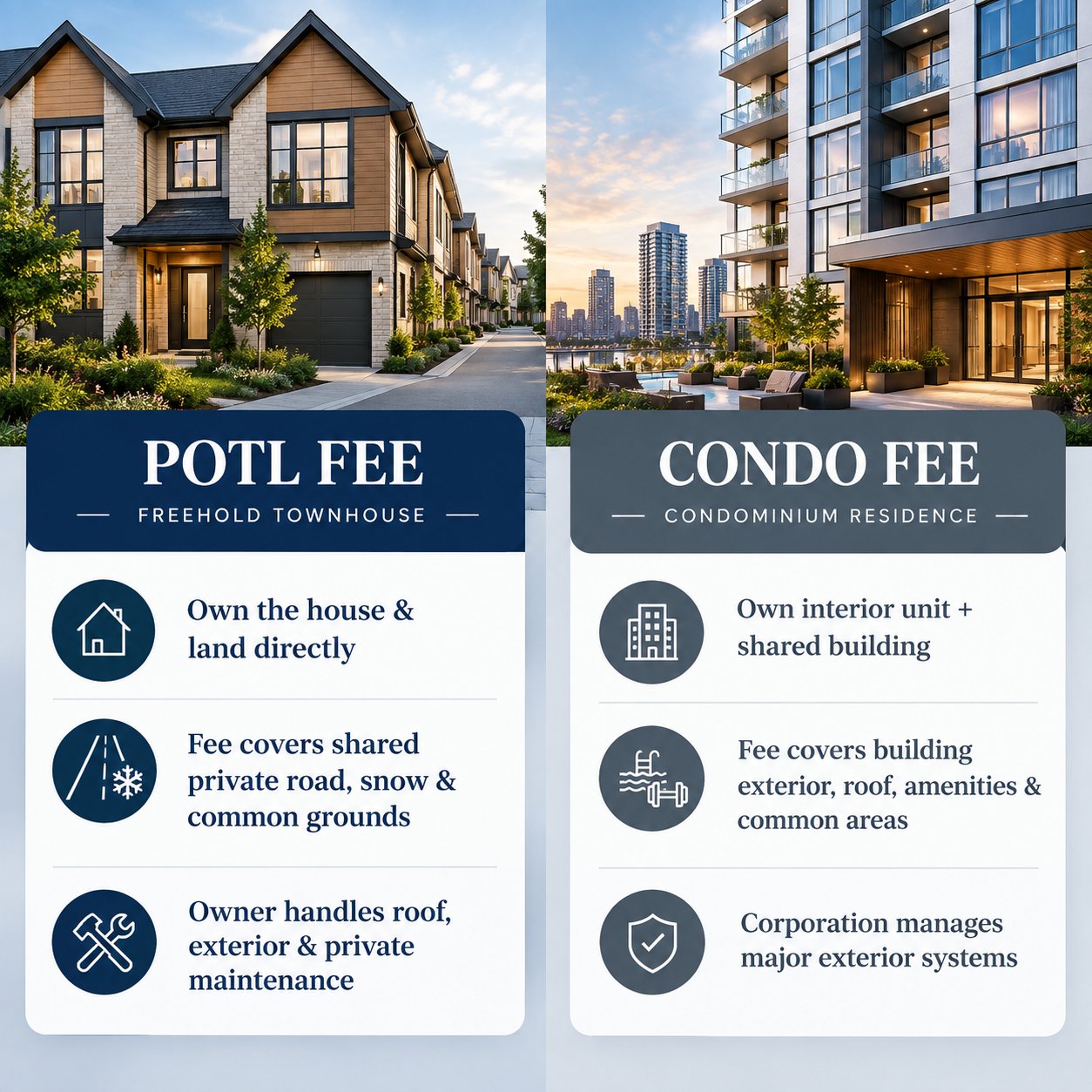
Imagine two townhomes with similar purchase prices. Property A is a freehold townhouse with a $110 monthly POTL fee. Property B is a condominium townhouse with a $540 monthly condo fee. At first glance, Property A may look far cheaper — but the comparison is incomplete. Property A may require the buyer to separately pay for exterior maintenance, roof replacement, window replacement, driveway repairs, private landscaping, more utilities, and separate snow clearing. Property B's condo fee may already include exterior maintenance, the roof and common building components, landscaping, snow removal, water, garbage, common-area insurance, and reserve-fund contributions.
Neither option is automatically better. The buyer must compare total ownership cost, maintenance responsibility, reserve-fund health, lifestyle fit, and future resale appeal — not just the sticker price of the fee. For a fuller picture of what to budget for beyond the fee itself, see Closing Costs in Ontario: Full Breakdown & Savings Tips for Homebuyers.
For first-time buyers, monthly POTL fees and condo fees can affect mortgage qualification. Lenders typically consider applicable housing costs — including a portion of condominium or POTL fees — when assessing affordability and debt-service ratios. This means two homes with the same purchase price can produce very different monthly carrying costs and different maximum approval amounts.
A low-fee POTL property can look more favourable on a lender's affordability calculation than a high-fee condo. But it's still important to budget separately for maintenance costs that a condo corporation might otherwise cover — a lender's math doesn't account for the roof you'll eventually have to replace yourself. Before house hunting, get a clear pre-approval and share the property's monthly fee with your mortgage professional; read Unlock Your Dream Home: Why Mortgage Pre-Approval is the First Step for why this comes before house hunting, not after. You may also want to review Fixed vs. Variable Mortgage Rates in 2025: What Ontario Buyers Need to Know when planning your monthly ownership budget, since your rate choice and the fee structure both influence cash flow.
A POTL property is not simply "a freehold home with a small extra fee." Treat it as a property with shared legal and financial obligations. Before making a firm offer, work through these questions with your agent and lawyer:
A well-structured condition on status-certificate review, where appropriate, gives you and your lawyer time to examine these documents before you become fully committed. A high-quality inspection can also help identify visible concerns with the unit, though an inspection doesn't replace document review — see Navigating the Home Inspection Process in Ontario for a complete walkthrough.
Sellers should be prepared for informed buyers to ask detailed questions about the monthly fee, what it covers, and the financial health of the corporation. Being organized helps your sale move more efficiently: state the fee clearly and accurately in the listing, explain what it covers based on current documents, avoid describing a home as "fully freehold with no fees" if a mandatory POTL obligation exists, order an up-to-date status certificate early, disclose known special assessments or approved projects through the appropriate process, and be prepared to explain homeowner-versus-corporation maintenance responsibilities.
A proactive listing strategy makes buyers more comfortable and reduces late-stage surprises. Learn more in The Ultimate Kitchener-Waterloo Home Seller's Guide and How to Sell Your Home Like a Pro: Mistakes Every Seller Should Avoid.
Choosing between a POTL property and a traditional condo often comes down to your preferred balance of independence, convenience, maintenance responsibility, and budget.
Families should weigh home type alongside community fit — school access, commute patterns, parks, bedroom count and future space needs all matter. For neighbourhood planning, see Top-Rated Schools in Kitchener-Waterloo: A Smart Move for Your Family & Your Future, and for buyers specifically weighing an affordable entry point, Best Kitchener Neighbourhoods for First-Time Home Buyers Under $700,000 is a useful starting point.
A POTL home can be freehold in the sense that you own the land and house, yet still carry mandatory common-element obligations.
A $150 POTL fee and a $600 condo fee aren't comparable unless you know what each covers and what maintenance remains personally yours.
The reserve fund is a major clue about whether the corporation is planning responsibly for future expenses.
It can reveal financial, legal, operational and rule-related issues a listing description simply can't capture.
A monthly fee affects cash flow — plan for property taxes, insurance, utilities, maintenance and savings, not only the mortgage and fee.
Rules may affect pets, rentals, short-term rentals, parking, renovation work, satellite dishes, barbecue use or home-based activities.
"I don't use the gym, so I shouldn't pay for it." Owners generally contribute according to the proportions in the declaration, regardless of whether they personally use every common element or amenity. "A low fee is always better." Not always — a low fee may reflect fewer services, lower current costs, or insufficient contributions for long-term repairs. Review the corporation's budget and reserve-fund information before drawing conclusions.
POTL arrangements are increasingly common in Waterloo Region's newer subdivisions — freehold townhome communities in Kitchener, Waterloo and Cambridge frequently share private laneways, visitor parking, and landscaped common areas that the municipality never takes on. If you're actively watching the local market while weighing a POTL versus condo purchase, the region's recent numbers add helpful context: see the Waterloo Region Real Estate Market Report: August 2026, the earlier Waterloo Region Market Update for July 2026, and Waterloo Region Real Estate: What's Really Happening This Spring for how condo and townhome segments have been trending.
Carrying costs matter just as much as the purchase price. Property taxes are a permanent part of your monthly budget alongside any POTL or condo fee — see How Much Will My Property Taxes Increase in 2026? and the related Kitchener Real Estate 2026: Budget Impact Market Update for how municipal budget decisions could affect what you pay. And if you're evaluating a specific POTL community's infrastructure, it's worth understanding regional water and servicing issues too — see Water Shortage in Kitchener-Waterloo: What Homeowners & Buyers Need to Know in 2026.
Whether a POTL townhome or a full-service condo fits you better often comes down to the same local trade-offs first-time buyers face across the region — see Sidak's Zero Down Program if your savings, not your fee comfort level, are the main barrier to entry.
POTL stands for Parcel of Tied Land. It describes a freehold home — such as a townhouse or detached house — where ownership of the house and land is legally tied to a common interest in a common-elements condominium corporation that manages shared assets like private roads, visitor parking or landscaping.
No. Both are mandatory recurring charges, but a POTL fee usually supports shared infrastructure outside your home, while a traditional condo fee usually supports the building itself. A POTL owner is typically responsible for more of their own home's exterior maintenance than a condo owner.
Not necessarily. A lower fee can simply mean fewer shared services, a newer community with fewer repair needs yet, or a reserve fund that isn't fully built up. The right question is what the fee includes, what remains your responsibility, and whether the corporation is financially prepared for future costs.
It's a key due-diligence document disclosing the declaration, bylaws, budget, audited financials, reserve-fund information, and any special assessments or litigation for a resale condo or POTL property. A corporation can charge up to $100 (including tax) and must provide it within 10 days of a request and payment.
An additional charge a condominium corporation may levy on owners when an expense isn't fully covered by the operating budget or reserve fund — for example an unplanned roof repair or a reserve-fund shortfall. Reviewing the reserve fund and status certificate helps buyers gauge this risk before making an offer.
Lenders typically factor recurring housing costs, including POTL and condo fees, into your debt-service ratios. A lower-fee POTL property can look more favourable on a lender's affordability calculation, but buyers should still budget separately for maintenance costs a condo corporation might otherwise cover.
The difference between a POTL fee and a condo fee isn't just about the monthly payment — it's about how the property is owned, who maintains what, what shared assets exist, how future repairs are funded, and what legal obligations follow the property after closing. Before committing to a purchase or sale, work with qualified professionals — including a real estate agent, mortgage professional, and Ontario real estate lawyer — to fully understand the property's condominium documents and financial obligations.
Contact Sidak Chhabra for a free, no-obligation consultation on POTL and condo properties across Kitchener, Waterloo, Cambridge and Guelph.
📞 519-496-1300 | ✉️ chhabrasidak0513@gmail.com | 🌐 la-casa.ca
Sidak Chhabra helps buyers and sellers navigate freehold, POTL and condominium purchases across the Kitchener-Waterloo Region — from Kitchener and Waterloo to Cambridge and Guelph. Browse more guides at la-casa.ca/blog.
Phone: 519-496-1300
Email: chhabrasidak0513@gmail.com
Website: www.la-casa.ca

“As a seasoned real estate expert serving Kitchener, Waterloo, Cambridge, Guelph, and surrounding areas, I offer a unique perspective shaped by my diverse background. Transitioning from a Commer....
The Complete First-Time Home Buyer's Guide to Kitchener-Waterloo (2026 Edition) 🏡A step-by-step roadmap from your first pre-approval conversation to the day you get your keys — built around
Ontario Homeownership Costs · 2026 GuidePOTL vs. Condo Fees in Ontario: What Buyers and Sellers Need to KnowThe listing looks like a freehold townhouse or detached home — yet it comes
📍 Serving Kitchener · Waterloo · Cambridge · Guelph 519-496-1300 · la-casa.caMarket Report · August 2026Waterloo Region Real Estate Market Report:
📍 Serving Kitchener · Waterloo · Cambridge · Guelph · London · la-casa.caOntario Mortgages · 2026 First-Time Buyer GuideYour Journey to
 Toronto Real Estate Board (TRREB); All information deemed reliable but not guaranteed. All properties are subject to prior sale, change or withdrawal. Neither listing broker(s) or information provider(s) shall be responsible for any typographical errors, misinformation, misprints and shall be held totally harmless. Listing(s) information is provided for consumer's personal, non-commercial use and may not be used for any purpose other than to identify prospective properties consumers may be interested
in purchasing. The data relating to real estate for sale on this website comes in part from the Internet Data Exchange program of the Multiple Listing Service. Real estate listings held by brokerage firms other than Royal Canadian Realty, Brokerage, Kitchener may be marked with the Internet Data Exchange logo and detailed information about those properties will include the name of the listing broker(s) when required by the MLS. Copyright ©2026 All rights reserved.
Last Updated: September 23, 2026 4:50 PM UTC
Show More...
Toronto Real Estate Board (TRREB); All information deemed reliable but not guaranteed. All properties are subject to prior sale, change or withdrawal. Neither listing broker(s) or information provider(s) shall be responsible for any typographical errors, misinformation, misprints and shall be held totally harmless. Listing(s) information is provided for consumer's personal, non-commercial use and may not be used for any purpose other than to identify prospective properties consumers may be interested
in purchasing. The data relating to real estate for sale on this website comes in part from the Internet Data Exchange program of the Multiple Listing Service. Real estate listings held by brokerage firms other than Royal Canadian Realty, Brokerage, Kitchener may be marked with the Internet Data Exchange logo and detailed information about those properties will include the name of the listing broker(s) when required by the MLS. Copyright ©2026 All rights reserved.
Last Updated: September 23, 2026 4:50 PM UTC
Show More...

The listing data displayed is deemed reliable but is not guaranteed accurate by CREA®. Data last updated on September 23, 2026 7:23 PM UTC The trademarks REALTOR®, REALTORS®; and the REALTOR® logo are controlled by The Canadian Real Estate Association (CREA®) and identify real estate professionals who are members of CREA®. Used under license. The trademarks MLS®, Multiple Listing Service® and the associated logos are owned by The Canadian Real Estate Association (CREA®) and identify the quality of services provided by real estate professionals who are members of CREA®. Used under license.
Show More...
 Data provided by the Ontario Regional Technology & Information Systems. The information is deemed reliable, but is not guaranteed. Not intended to solicit buyers or sellers, landlords or tenants currently under contract.
The trademarks REALTOR®, REALTORS® and the REALTOR® logo are controlled by The Canadian Real Estate Association (CREA) and identify real estate professionals who are members of CREA. The trademarks MLS®, Multiple Listing Service® and the associated logos are owned
by CREA and identify the quality of services provided by real estate professionals who are members of CREA. Used under license.
REALTOR® contact information provided to facilitate inquiries from consumers interested in Real Estate services. Please do not contact the website owner with unsolicited commercial offers.
Show More...
Data provided by the Ontario Regional Technology & Information Systems. The information is deemed reliable, but is not guaranteed. Not intended to solicit buyers or sellers, landlords or tenants currently under contract.
The trademarks REALTOR®, REALTORS® and the REALTOR® logo are controlled by The Canadian Real Estate Association (CREA) and identify real estate professionals who are members of CREA. The trademarks MLS®, Multiple Listing Service® and the associated logos are owned
by CREA and identify the quality of services provided by real estate professionals who are members of CREA. Used under license.
REALTOR® contact information provided to facilitate inquiries from consumers interested in Real Estate services. Please do not contact the website owner with unsolicited commercial offers.
Show More...